
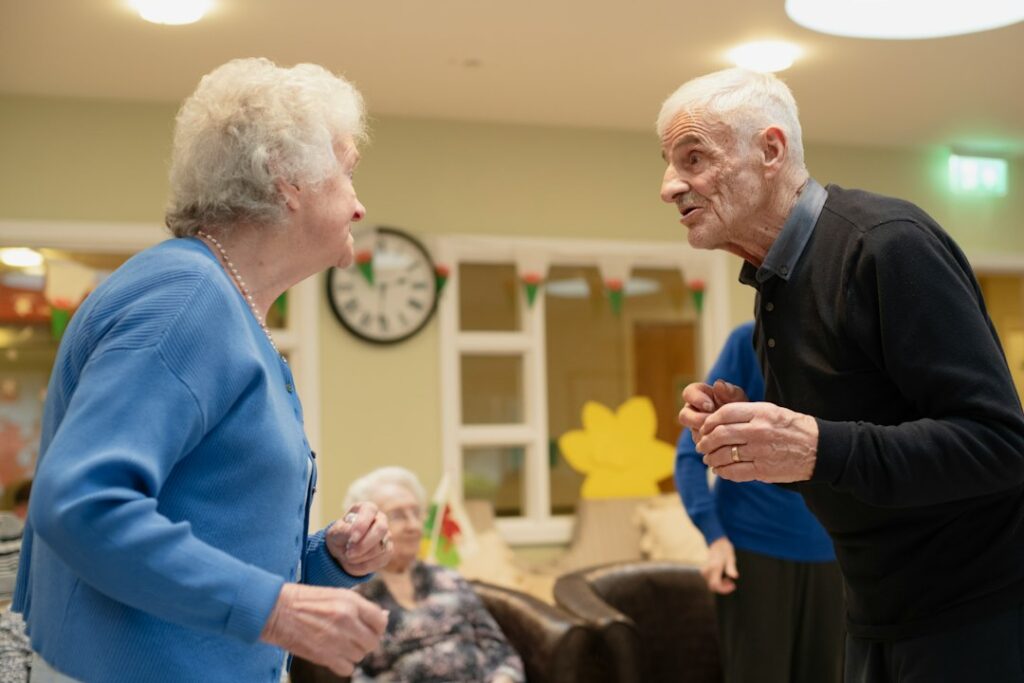
Why conflict can happen in assisted living
Conflict in an assisted living residence often begins with an unmet need, misunderstanding, change in routine, or concern about personal choices. Addressing the issue early and respectfully can prevent a disagreement from becoming a lasting source of stress.
Residents may experience conflict with:
- Another resident over noise, shared spaces, television, belongings, or personal boundaries
- Staff members regarding schedules, medications, meals, bathing, housekeeping, or communication
- Family members who disagree about care decisions, finances, visits, or safety
- Roommates or neighbors with different sleep schedules, habits, personalities, or levels of independence
A disagreement does not always mean someone is acting unfairly. Assisted living brings together people with different backgrounds, health conditions, communication styles, and expectations. Memory loss, hearing difficulty, pain, anxiety, depression, medication effects, or fatigue can also make ordinary problems feel more intense.
What should a resident do first?
The first step is to identify the specific problem and decide whether anyone is in immediate danger. If there is physical violence, a serious threat, suspected abuse, neglect, exploitation, or a medical emergency, seek immediate help from staff or emergency services rather than trying to negotiate alone.
For a routine disagreement, pause before responding. A calm conversation is more likely to succeed when the people involved are not angry, rushed, hungry, or exhausted. Consider asking:
- What exactly happened?
- Who was present?
- Is this a one-time problem or a repeated pattern?
- What outcome would feel fair and reasonable?
- Is a health condition affecting the situation?
Use clear, direct language. “The television kept me awake after quiet hours” is more useful than “You always cause problems.” Describing the behavior and its effect keeps the conversation focused on solving the issue instead of assigning blame.
How can residents talk through a disagreement?
A respectful conversation should take place in a quiet, private setting when possible. Residents can use “I” statements, such as:
- “I feel uncomfortable when people enter my room without knocking.”
- “I need help understanding why my usual meal time changed.”
- “I would like a plan for sharing the common room.”
- “I am concerned that my request was not recorded.”
Listen to the other person’s explanation without interrupting. Listening does not mean agreeing with every statement. It helps reveal whether the disagreement involves a misunderstanding, a communication barrier, or a problem that requires staff involvement.
Avoid threats, insults, public arguments, blocking doorways, taking another person’s belongings, or spreading accusations among other residents. These actions can increase tension and may make it harder for staff to determine what happened.
If the other person becomes aggressive, confused, or unable to have a productive conversation, end the discussion and move to a safer area. Ask a trusted staff member to help.
When should staff become involved?
Staff should be included when the disagreement affects safety, care, privacy, sleep, medication, meals, mobility, finances, room access, or the ability to use shared areas. Staff involvement is also appropriate when a resident has tried to resolve the matter directly and the problem continues.
A resident may ask for a meeting with the staff person responsible for the concern, such as a supervisor, nurse, care coordinator, or administrator. The discussion should focus on facts and possible solutions.
Helpful information includes:
- The date, time, and location of each incident
- The people involved and anyone who witnessed it
- What was said or done
- How the incident affected the resident
- Whether the issue has happened before
- What response has already been attempted
Written notes can be useful, especially when several events occur over time. Keep descriptions factual and avoid guessing about another person’s motives.

Possible solutions may include changing seating arrangements, setting quiet-hour expectations, creating a shared-space schedule, improving communication about care routines, adding privacy measures, or arranging a care-plan review. A solution should respect the rights and dignity of everyone involved.
What if the conflict involves dementia or another cognitive condition?
A resident with dementia may not be able to explain a concern clearly or remember a previous conversation. Arguing about details or insisting that the person “should remember” often makes the situation worse.
Staff and family members can look for patterns. Conflict may occur at a particular time of day, during personal care, in crowded areas, or when the resident is tired or overstimulated. Pain, constipation, infection, dehydration, poor sleep, medication changes, and difficulty hearing or seeing can contribute to sudden changes in behavior.
Helpful responses may include:
- Speaking slowly and using short, reassuring sentences
- Offering two simple choices instead of demanding an immediate decision
- Moving to a quieter area
- Allowing extra time for the person to respond
- Redirecting attention when discussion becomes repetitive
- Asking the care team whether a health assessment is needed
A cognitive condition may explain behavior, but it does not make abuse acceptable. Safety and respectful treatment remain necessary.
How should families handle disagreements with staff?
Family members should avoid arguing in hallways, in front of other residents, or during a rushed care task. Requesting a planned conversation usually allows more time for questions and documentation.
Bring a short list of concerns and separate urgent matters from general preferences. Ask staff to explain the relevant policy, care-plan decision, or safety reason. Families can also ask what information is needed from them and when they should expect an update.
If family members disagree with one another, the resident’s preferences and legal decision-making arrangements should guide the discussion whenever possible. A resident who can make informed choices should not be treated as absent from decisions simply because relatives have different opinions.
What are a resident’s complaint rights in Pennsylvania?
Assisted living residents in Pennsylvania have the right to be treated with dignity and to raise concerns about rights, care, or other residence matters without intimidation or retaliation. The residence must provide information about complaint procedures, and complaints may generally be made orally or in writing.
Residents should ask for the residence’s grievance or complaint process if it is not readily available. A written complaint should identify the concern, the requested resolution, and the date it was submitted. Keep a copy if possible.
If the residence does not resolve a serious concern, residents or designated representatives may seek outside assistance through Pennsylvania’s assisted living licensing system, the Long-Term Care Ombudsman Program, protective services when appropriate, disability rights resources, or law enforcement for suspected criminal conduct.
A complaint is different from an ordinary personality conflict. Concerns involving abuse, neglect, financial exploitation, discrimination, unsafe care, retaliation, or repeated failure to provide agreed services should be treated as serious matters.
What can help prevent future conflict?
Prevention often depends on clear expectations and early communication. Residents and families can review the residence rules, care plan, visiting expectations, quiet hours, shared-space practices, and procedures for raising concerns.
In the Greencastle community, seasonal conditions can affect routines. Winter weather may limit outdoor activities, increase time spent indoors, and add stress when transportation or visits are delayed. Planning indoor activities, confirming communication arrangements, and allowing flexibility during difficult weather can reduce tension.
Respectful conflict resolution does not require every person to agree. It requires a safe process, accurate information, reasonable boundaries, and attention to each resident’s dignity.
